Dedicated to [D. Jesus Martinez Frias](/en/buscar/?q=Jesús Martínez Frías)
Introduction: The Two Impenetrable Jungles
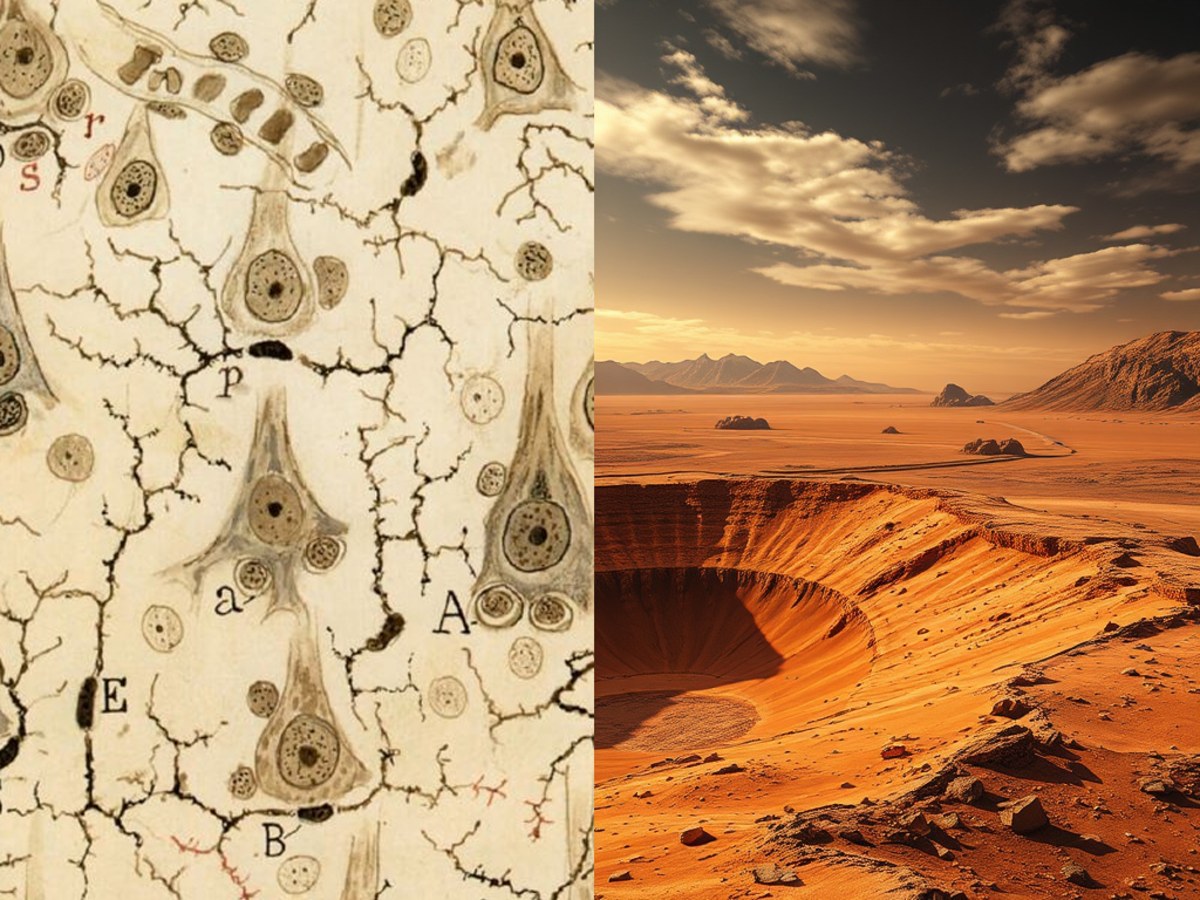
What do the delicate “butterflies of the soul” that Santiago Ramon y Cajal drew at the end of the nineteenth century have in common with the search for microfossils in the arid soil of Mars? At first glance, they seem worlds (literally) apart. One is an inner universe of biological complexity; the other, a silent wasteland millions of kilometers away. Yet a golden thread connects the Spanish Nobel laureate’s laboratory with the rovers that today explore the red planet. It is a thread woven from the principles of a single scientific philosophy: the art of observing with patience, the audacity to interpret the ambiguous, and the genius to make the invisible visible.
When Cajal peered into his microscope, he faced a landscape no less alien than Jezero Crater. The brain was, in his own words, an “impenetrable jungle” (“selva impenetrable”), a “neuronal forest” whose laws and inhabitants — the neurons — no one had been able to map. Analogously, when NASA’s Perseverance rover landed in Jezero Crater, it encountered an ochre and desolate landscape, an ancient lake bed harboring the secrets of a world that may or may not have once hosted life.
We shall explore the surprising parallelism between the neuroscience revolution led by Cajal and modern astrobiology, a discipline that, in essence, applies the same principles of our sage on a cosmic scale. We will follow this thread from Cajal’s laboratory to the control rooms of the Centro de Astrobiologia (CAB, CSIC-INTA), travel to the Martian landscapes of Spain that serve as training grounds, and land on Mars to see how a Spanish scientific legacy continues to shape one of humanity’s greatest adventures.
The Cartography of the Butterflies of the Soul
To understand the connection with Mars, we must first appreciate that Santiago Ramon y Cajal was not merely a scientist but the master cartographer of an unknown biological continent. His success was owed not only to technique but to a philosophy of science that combined relentless empirical rigor with artistic sensitivity and an interpretive capacity that transformed biology forever.
The Philosophy of the Attentive Eye
The foundation of Cajal’s method was a crucial epistemological distinction: the difference between the passive act of “seeing” and the intellectual act of “observing.” Looking through the eyepiece was not enough; one had to interrogate the image, search for patterns, doubt first impressions, and above all, interpret. This conviction was forged in his struggle against the prevailing “reticular theory,” which postulated that the nervous system was a continuous, undifferentiated network. For Cajal, this theory was the product of lazy observation, a capitulation before complexity. As he himself declared, “To affirm that everything communicates with everything amounts to declaring the absolute unknowability of the organ of the soul” (“Afirmar que todo se comunica con todo vale tanto como declarar la absoluta incognoscibilidad del organo del alma”). For him, true knowledge could not arise from accepting a homogeneous chaos, but from the patient labor of discerning its fundamental units.
This philosophy was reflected in a legendary work ethic. He spent working days of up to fifteen hours in his laboratory, driven by a “fever to publish” that was not vanity but the conviction that the act of writing and drawing was the final crystallization of scientific thought. His magnum opus, Rules and Advice on Scientific Research (Tonics of the Will), is a testament to this belief in discipline, patience, and will as scientific tools every bit as important as the microscope. His curiosity overflowed the boundaries of the laboratory, even manifesting in a lesser-known facet: science fiction. In his Vacation Stories, written between 1885 and 1886, Cajal explored pseudoscientific narratives in which his imagination ran ahead of his time. In one of them, “The Corrected Pessimist” (“El pesimista corregido”), he describes a character who, with an improved telescope, resolves “the most arduous problems of physics, chemistry, and planetary biology: the Moon’s atmosphere, the habitability of Jupiter, the question of the canals of Mars…” The fact that Cajal used the term “planetary biology” and engaged with the debate over the Martian canals reveals a vision that connects directly to modern astrobiology.
The Pencil as an Instrument of Thought
In the Cajalian method, drawing was not a secondary act of illustration but the primary act of synthesis and interpretation. His famous depictions of the Purkinje cells of the cerebellum or the pyramidal cells of the cortex — which he poetically called “butterflies of the soul” (“mariposas del alma”) — were not simple copies of what he saw. Cajal rarely traced. Instead, he observed multiple preparations and different focal planes to construct in his mind a three-dimensional “composite image,” an idealized version that captured the morphological essence of the neuron.
This process reveals a profound conviction in the “suggestiveness of form”: the idea that the structure of a neuron directly reveals its function. The vast arborization of a Purkinje cell, for example, suggested its role as an integrator of an immense amount of information. This fusion of science and art, of positivism and romanticism, is what makes his drawings so powerful. They are not mere representations; they are visual arguments. As the painter Paul Klee remarked, “Art does not reproduce what we see; rather, it makes us see.” Cajal’s drawings made us see the neuron for the first time. His belief that truth and beauty are intertwined in nature is the key to his genius, transforming his illustrations into scientific documents of enduring value.
The Neuron Doctrine
The culmination of his method was the “Neuron Doctrine,” the theory establishing that the nervous system is composed of individual, discrete cells (neurons) that communicate with one another by contact at specialized points (synapses), not by physical continuity. By overthrowing the reticular theory, Cajal provided the fundamental “alphabet” of the nervous system. This advance was not merely a discovery but the establishment of a universal methodological principle: to understand any complex system, whether a brain or a planetary ecosystem, one must first identify its constituent parts. It is this principle that guides astrobiology today in its search for the fundamental units of life on other worlds.
The New Cosmos: Deciphering the Echoes of Life on Mars
Modern astrobiology, the interdisciplinary science that studies the origin, evolution, and distribution of life in the universe, faces a challenge conceptually identical to Cajal’s: how to find order and meaning in an apparently chaotic and unknown landscape. The Mars 2020 mission with the Perseverance rover is the most sophisticated embodiment of this quest, a direct heir to the methodological legacy of the Spanish sage.
The Science of Traces: In Search of Biosignatures
The central objective of astrobiology on Mars is not to find a living organism but its traces: “biosignatures” or “biomarkers.” A biosignature is any substance, object, or pattern whose existence or origin can be attributed to a vital process. They may be complex organic molecules, certain types of minerals, specific isotopic patterns, or even microscopic fossil structures.
The principal scientific challenge lies in ambiguity. Nature is a master of deception, and many non-biological geological processes can produce signals that mimic those of life. For example, the methane detected in the Martian atmosphere, which on Earth is overwhelmingly a biological byproduct, can also be generated by geological reactions such as volcanism. Similarly, the complex organic molecules that Perseverance has found in abundance in Jezero Crater are the “building blocks of life” but not conclusive proof of it, since they can also form abiotically. This is the astrobiological equivalent of Cajal’s “impenetrable jungle”: a torrent of ambiguous data in which the signal of life must be carefully distinguished from the noise of geology.
This challenge is magnified by what in the philosophy of science is known as the “N=1 problem.” Our entire understanding of life is based on a single example: life on Earth. When searching for life on other worlds, we extrapolate from this single data point, which forces us to make assumptions about how life might manifest in a different chemical and geological context. The difficulty of interpreting biosignatures is a direct consequence of this fundamental limitation.
Perseverance in Jezero Crater: A Calculated Search
The Mars 2020 mission is not a random expedition. The landing of the Perseverance rover on February 18, 2021, in Jezero Crater was the result of years of scientific deliberation. This site was chosen because orbital images revealed that, approximately 3.5 billion years ago, it was a lake fed by a river that formed a well-preserved delta. On Earth, river deltas are excellent environments for the preservation of organic matter and fossils. Therefore, Jezero represents the site with the highest probability not only of having harbored microbial life but also of having preserved its traces in sedimentary rocks.
The rover’s slow and methodical journey, documented in videos transmitted from Mars, is a testament to the “explorer’s patience” that Cajal championed. Each rock analyzed, each regolith sample drilled, is a step in a systematic process designed to resolve the ambiguity of biosignatures, applying Cajalian rigor on a planetary scale.
From Silver Staining to Laser Beams: The Evolution of the Explorer’s Toolkit
The connection between the nineteenth-century laboratory and the twenty-first-century Martian surface becomes tangible when we compare the tools employed. Although technology has advanced exponentially, the functional objective remains the same: to isolate a meaningful signal from a complex and noisy background.
Illuminating One Among a Million
The tool that allowed Cajal to unravel the neuronal jungle was the “reazione nera,” or Golgi method. Its genius lay in its apparent imperfection: for reasons still not entirely understood, the silver chromate stain colors only a small percentage of neurons in a tissue sample black. However, those it stains, it stains completely, from the soma to the finest terminals of its axons and dendrites. This selectivity was its greatest virtue. It allowed Cajal to see individual “trees” for the first time instead of an impenetrable “forest,” isolating the fundamental unit of the system for study.
Spain’s Eyes on Mars: SuperCam and RLS
The modern equivalents of the Golgi stain are the advanced spectrometers equipping the Martian rovers, instruments in which Spanish science and engineering play a leading role.
The SuperCam instrument, mounted on the mast of Perseverance, is a marvel of miniaturization. It uses a laser to vaporize a tiny spot on a rock at a distance of up to seven meters. It then analyzes the light emitted by the resulting plasma to determine its elemental chemical composition (LIBS technique) and employs a second laser to analyze molecular vibrations and identify the mineralogical composition (Raman spectroscopy). This powerful combination enables detailed geological characterization at a distance. The Spanish contribution to this instrument is crucial: the entire complex calibration system, essential for ensuring the precision of measurements, was developed and led by a consortium of Spanish institutions headed by researcher Fernando Rull of the University of Valladolid, with the participation of the University of the Basque Country, the University of Malaga, the Complutense University of Madrid, and INTA.
Even more significant is Spain’s participation in the Raman Laser Spectrometer (RLS), a key instrument destined for the Rosalind Franklin rover of ESA’s ExoMars mission. The RLS is specifically designed to identify organic compounds and minerals associated with biological activity. The development of this instrument has been an international effort, but the Spanish contribution, led by the Centro de Astrobiologia (CAB), represents approximately 80% of the total, including such critical components as the optical head that focuses the laser and collects the signal.
The functional analogy is direct and powerful. Just as the Golgi stain “illuminated” one neuron among a million, spectrometers such as SuperCam and RLS isolate the “spectral fingerprint” — the unique luminous signature — of a specific mineral or organic molecule within the geological matrix of a Martian rock. Both are methods for extracting a clear signal from an overwhelmingly complex environment.
| Characteristic | Santiago Ramon y Cajal (Neuroscience, 19th c.) / Mars Exploration (Astrobiology, 21st c.) / Frontier |
|---|---|
| Objective | Identify the fundamental unit (the neuron). Identify the unit of life (the biosignature). |
| Isolation Tool | Silver stain (Golgi method). Laser spectrometry (SuperCam, RLS). |
| Isolation Principle | Stochastic staining that reveals a complete neuron. Isolation of the “spectral fingerprint” of molecules. |
| Synthesis Tool | Freehand drawing (synthetic interpretation). Data visualization and false color (computational interpretation). |
| Philosophical Principle | ”Seeing is not observing.” The necessity of interpretation. Distinguishing biosignatures from abiotic processes. |
| Spanish Contribution | Foundation of modern neuroscience. Leadership in instrumentation (RLS) and calibration (SuperCam). |
This transition of tools reveals a fundamental shift in scientific approach: from morphology to chemistry. Cajal deduced function from form. Modern astrobiology infers past function (life) from chemical composition (biosignatures). Yet the underlying cognitive act is identical: interpreting an isolated and specific signal to construct a broader narrative about a complex system. Technology has evolved, but the scientific purpose endures.
Martian Landscapes in the Heart of Spain
Spain’s contribution to astrobiology is not limited to historical inspiration or cutting-edge engineering; it is also geographical. Spanish territory harbors some of the world’s most important terrestrial analogs, natural laboratories that are indispensable for preparing Mars missions.
Rio Tinto: A Martian Subsurface in Huelva
The landscape of Rio Tinto, in the province of Huelva, possesses an extraterrestrial beauty. Its waters, an intense red due to an extremely acidic pH and a high concentration of heavy metals, flow through terrain dyed in ochres and oranges that immediately evoke images of the red planet. For decades it was thought that these extreme conditions were the result of contamination from the area’s millennia-old mining activity.
However, pioneering research led by microbiologist Ricardo Amils and his team at the Centro de Astrobiologia (CAB) demonstrated a much deeper and more astrobiologically relevant truth. They discovered that the source of the river’s acidity is not mining but a gigantic subterranean “bioreactor.” In the depths of the Iberian Pyrite Belt, a vast community of microorganisms thrives in the total absence of oxygen and sunlight, obtaining its energy from the oxidation of minerals such as pyrite. This anaerobic metabolism is what releases the acid and metals that characterize the river. The discovery of this “dark, deep biosphere” is of paramount importance, for it offers a plausible model of how life could exist on Mars today: shielded from the hostile radiation at the surface, underground, and using chemoautotrophic metabolic pathways to subsist. Rio Tinto is not merely a place that resembles Mars; it is a place that functions as a Martian ecosystem might.
Lanzarote: A Volcanic Testing Ground
If Rio Tinto is an analog of the Martian subsurface, the volcanic landscapes of Lanzarote are an analog of its surface. The Timanfaya National Park, with its vast fields of black lava (“malpais”), its volcanic cones, and its lava tubes, offers terrain geologically very similar to many regions of Mars. The planetary geologist and eminent Cajalian Jesus Martinez Frias, of the Institute of Geosciences (IGEO, CSIC-UCM), has been a key figure in establishing the island as a first-rate natural laboratory for planetary geology.
Lanzarote’s utility is eminently practical. The European Space Agency (ESA) and NASA use the island for the PANGAEA project, a geological training program for astronauts. Here, in a safe and controlled environment, future planetary explorers learn to identify geological formations, collect samples, and operate technology on terrain that simulates the challenges of a real mission. The connection is so strong that, in a symbolic gesture, scientists on the Mars 2020 mission named one of the grid squares of Perseverance’s landing zone “Timanfaya,” carrying a piece of Spain to Jezero Crater.
These analogs create a virtuous circle that consolidates Spanish leadership in the field. The unique geology of places like Rio Tinto and Lanzarote attracts collaboration from international space agencies. This collaboration brings funding, prestige, and access to top-tier missions, which in turn strengthens institutions like CAB and IGEO. This enables Spanish scientists to lead the development of cutting-edge instrumentation such as the RLS, thereby securing a leading role in future missions. Spain’s own land becomes a strategic asset that drives a cycle of scientific excellence.
The Magnetic Thread: From Magnetites of the Brain to the Dust of Mars
Beyond methodological and geographical analogies, there exists an even more direct and surprising connection linking neuroscience to Mars exploration — a bond at the mineralogical level. This connection, highlighted by planetary geologist Jesus Martinez Frias, creates a literal bridge between the brain and outer space.
The story begins in 1992, when CALTECH geologist Joseph Kirschvink made an extraordinary discovery: the presence of millions of magnetite crystals (an iron oxide) in the human brain. This finding suggested that our brains contain a ferromagnetic mineral, opening an entirely new field of research into its possible functions.
Four years later, in 1996, a remarkable scientific coincidence occurred. A team led by David McKay of NASA announced the discovery of possible biosignatures in the famous Martian meteorite ALH84001. One of the most compelling pieces of evidence was a set of tiny chains of magnetite crystals, morphologically identical to those produced on Earth by magnetotactic bacteria to orient themselves in the terrestrial magnetic field. NASA became extremely interested in determining whether these Martian magnetites could have a biological origin, and Kirschvink himself, the discoverer of brain magnetites, was one of the key scientists involved in their analysis. Suddenly, the same mineral was the protagonist of two of the most exciting frontiers of science: understanding the brain and the search for life on Mars, establishing an unexpected “brain-space” connection that Cajal, with his insatiable curiosity, would undoubtedly have relished.
The Aesthetics of Truth: The Art of Scientific Vision
The final thread linking Cajal to Mars is the most subtle and, perhaps, the most profound. It concerns the role of visualization and aesthetic interpretation in the construction of scientific knowledge. Both Cajal’s drawings and NASA’s images of Mars challenge the naive notion that a scientific image is a simple copy of reality. In both cases, a certain “artifice” is employed to reveal a deeper truth.
Cajal’s Interpretive Realism
As noted above, Cajal’s drawings were not photographs. They were interpretations. By synthesizing multiple observations into a single image, Cajal chose which elements to emphasize and which to omit in order to achieve maximum explanatory clarity. He himself considered them “fragments of reality, scientific documents that preserve their value indefinitely” (“pedazos de la realidad, documentos cientificos que conservan indefinidamente su valor”). By adding arrows to indicate the direction of nerve flow, for example, he transformed a static anatomical diagram into a dynamic physiological map, communicating an idea, not merely a form. His work was a visual language designed to persuade and explain.
Painting Mars by Numbers: Truth in False Color
Analogously, many of the most spectacular and scientifically valuable images we receive from Mars are “false color” composites. This does not mean they are false, but rather that colors have been assigned to wavelengths of light, often outside the human visible spectrum (such as infrared), to highlight subtle differences in mineralogical composition or terrain texture.
NASA openly explains that the purpose of these images is not to show the landscape as an astronaut would see it but to provide geologists with a data visualization tool. A bluish tone may indicate the presence of a type of sulfate, while a green one may signal olivine. Color becomes a layer of information, a chemical map superimposed on the landscape.
Herein lies the final parallelism: just as Cajal created an “artificial” image (a composite that never existed under the microscope in a single instant) to reveal a “true” principle (the individual structure of the neuron), NASA creates “false color” images to reveal a “true” geology that would otherwise remain invisible. Both acts challenge the idea of scientific objectivity as a simple photographic transcription of reality. They demonstrate that the advancement of knowledge often requires a deliberate act of interpretation, of aesthetic choice, and of translating complex data into a visual language that the human mind can comprehend. Objectivity resides not in the absence of human intervention but in the creation of a model of reality that is communicable, verifiable, and predictive.
Conclusion: The Unifying Force of Curiosity
The legacy of Santiago Ramon y Cajal is a living current that flows through Spanish and world science. The philosophy of patient observation and audacious interpretation that he perfected to map the inner cosmos of the brain is the same one that today guides the exploration of the outer cosmos. This heritage has been institutionalized in centers of excellence like CAB, tested in the natural laboratories of Rio Tinto and Lanzarote, materialized in the engineering of instruments such as SuperCam and RLS, and practiced every day on the surface of Mars.
The search continues. The next chapter of this saga will be the Mars Sample Return mission, an ambitious joint project of NASA and ESA that will bring to Earth the samples that Perseverance is currently collecting, allowing their analysis in the world’s most advanced laboratories. Beyond that, astrobiology is already looking toward the icy moons of Jupiter and Saturn, such as Europa and Enceladus, worlds with subsurface oceans where the same principles of searching for life will be applied in even more exotic environments.
The next time we contemplate an image transmitted from the red planet — a panorama of ochre rocks beneath a rosy sky — let us remember the man who, armed with a microscope, ink, and paper, showed us that the most thrilling exploration is one that dares to seek the delicate butterflies of the soul where others see only inert chaos. Whether in the jungles of the mind or in the dust of other worlds, the method for mapping the invisible remains the same.
Bibliography
-
Amils, R., et al. (2022). Coupled C, H, N, S and Fe biogeochemical cycles operating in the deep subsurface of the Iberian Pyrite Belt. Environmental Microbiology, 24(12), 6313-6334.
-
Aretxaga-Burgos, R. (2015). Hacia una filosofia de la astrobiologia. Pensamiento, 71(269), 1083-1118.
-
Bullock, T. H., et al. (2005). The Neuron Doctrine, Redux. Science, 310(5749), 791-793.
-
DeFelipe, J. (2010). Cajal y sus dibujos: ciencia y arte. Revista de la Real Academia de Ciencias Exactas, Fisicas y Naturales, 103(1), 199-224.
-
Farley, K. A., et al. (2020). Mars 2020 Mission Overview. Space Science Reviews, 216(8), 142.
-
Fernandez-Remolar, D. C., et al. (2017). Finding of fluidified sediment structures on Mars. Geology, 45(8), 739-742.
-
Liu, Y., et al. (2022). An olivine-rich igneous unit on the Jezero crater floor. Science, 377(6614), 1513-1519.
-
Mangold, N., et al. (2021). Perseverance rover reveals ancient delta-lake system and volcanic rocks at Jezero crater, Mars. Science, 374(6572), 1237-1242.
-
Martinez Frias, J. (2025). De Cajal a la exploracion astrobiologica de Marte: Ciencia, ficcion y educacion STEAM. Revista Qurriculum, 38, 95-109.
-
Martinez-Frias, J. (2021). 2021: El Ano de Marte. Tierra y Tecnologia, 57.
-
Martinez-Frias, J. (2024). Geologia planetaria: la importancia de los analogos terrestres en la investigacion paleoambiental y astrobiologica de Marte. Discurso de ingreso, Real Academia de Ciencias Exactas, Fisicas y Naturales, Madrid.
-
Martinez-Frias, J., et al. (2006). UV radiation screening by basaltic and sulfate-rich regoliths on Mars. Icarus, 181(1), 52-58.
-
Martinez-Frias, J., et al. (2015). Brine formation by deliquescence of perchlorates on Mars. Nature Geoscience, 8(5), 357-361.
-
Maurice, S., et al. (2021). The SuperCam Instrument Suite on the Perseverance Rover: A Preview of the Science. Space Science Reviews, 217(4), 59.
-
Ramon y Cajal, S. (1894-1904). Textura del Sistema Nervioso del Hombre y los Vertebrados. Moya.
-
Ramon y Cajal, S. (1917). Recuerdos de mi vida. Moya.
-
Ramon y Cajal, S. (1940). Reglas y consejos sobre investigacion cientifica (Los tonicos de la voluntad) (8th ed.). Libreria Beltran.
-
Rodriguez-Manfredi, J. A., et al. (2021). The Mars Environmental Dynamics Analyzer, MEDA. A Suite of Environmental Sensors for the Mars 2020 Mission. Space Science Reviews, 217(3), 48.
-
Rull, F., et al. (2017). The Raman Laser Spectrometer for the ExoMars Rover Mission to Mars. Astrobiology, 17(6-7), 627-654.
-
Salomone, S. (Ed.). (2002). Astrobiologia: del Big Bang a las civilizaciones. Equipo Sirius.
-
Waldeyer, H. W. G. (1891). Ueber einige neuere Forschungen im Gebiete der Anatomie des Centralnervensystems. Deutsche medicinische Wochenschrift, 17(44), 1213-1218.
-
Wiens, R. C., et al. (2021). The SuperCam Instrument Suite on the Perseverance Rover: Body Unit and Combined System Tests. Space Science Reviews, 217(1), 4.
-
Zimbelman, J. R., & Crown, D. A. (2015). Geologic map of the Ceraunius Fossae/Uranius Patera region of Mars. US Geological Survey Scientific Investigations Map, 3330.