I. The Return of the Butterflies: The London Closing of Cajal
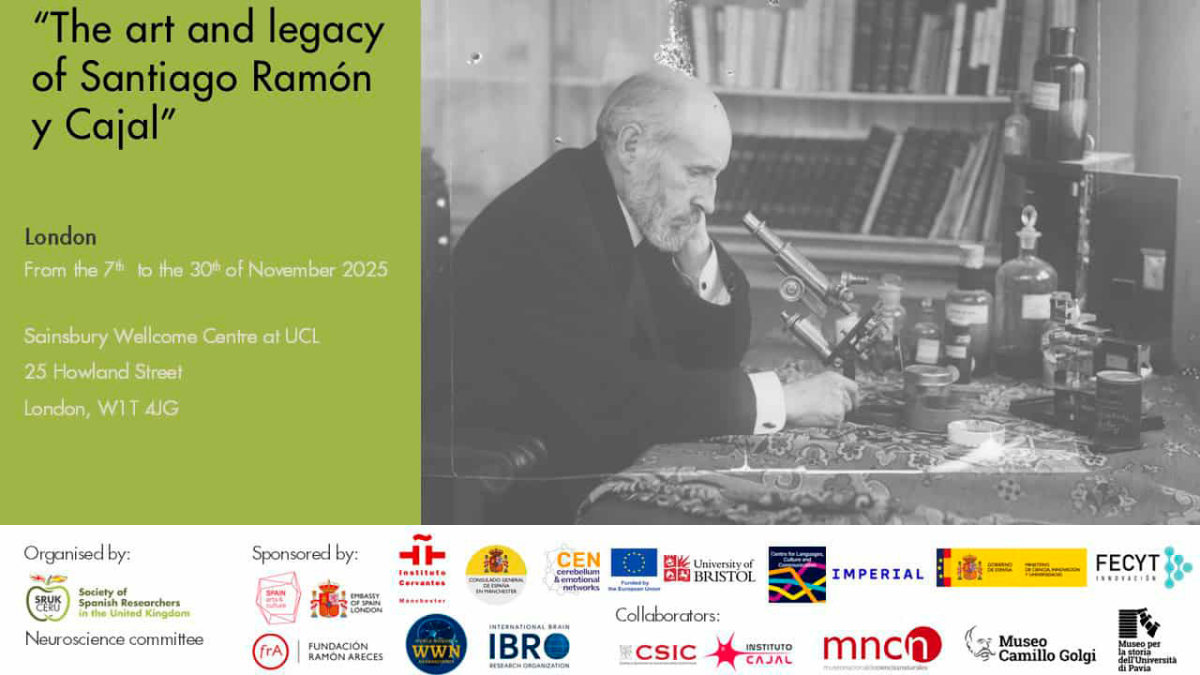
The scene takes place at the Sainsbury Wellcome Centre (SWC) at University College London. It is 7 November 2025, a Friday evening in the beating heart of British neuroscience. This event is not an inauguration. It is the “final stop” — the conclusion of an ambitious year-long touring exhibition, “The Art and Legacy of Santiago Ramón y Cajal,” which has taken the Nobel laureate’s work across the United Kingdom: from its start at Imperial College London in March, through Manchester, Bristol, York, and Edinburgh. Now, the legacy returns to London for its grand finale.
The first talk is by our admired and beloved José Ramón Alonso, Professor and former Rector of the University of Salamanca: “Cajal, the man, the myth, the scientist… and more.” The second, by Professor Zoltán Molnár of the University of Oxford, on “Cajal’s interactions with Sherrington” — revealing the deep historical connection between these two titans of neuroscience who met only once, in London in 1894, during Cajal’s Croonian Lecture at the Royal Society.
II. The Architect of the Brain: The Man Who Drew Thought
Cajal’s drawings were not mere illustrations. They were visual epistemology — arguments, acts of intellectual synthesis. The touring exhibition centred on communicating his scientific legacy through his three foundational contributions: the Neuron Theory, the Law of Dynamic Polarisation, and the Discovery of Dendritic Spines.
III. A Diplomacy of Networks: The Purpose of SRUK/CERU
The Society of Spanish Researchers in the United Kingdom (SRUK/CERU), founded in 2012 with more than 700 members, organised this touring exhibition as the ultimate expression of its triple mission: networking, science communication, and scientific diplomacy.
IV. The Tour: A Story in Five Acts
Each stop was a thematically curated symposium: Imperial College (the living legacy and modern neuroscience), Manchester Cervantes Institute (deconstructing the solitary genius; women in Cajal’s school), Bristol Wills Memorial (the emotional brain and art-science fusion, including the Cajal Embroidery Project and sculptor Dr. Annie Campbell), York and Edinburgh (expanding the vision).
V-VI. Conclusion: A Legacy in Living Tissue
The true “legacy” of Cajal, as this tour demonstrated, is not just the drawings preserved in the CSIC archives. The legacy is the working network — the “living tissue” of researchers who continue his work. The Cajal tour across the United Kingdom was not a history lesson; it was a declaration of presence.