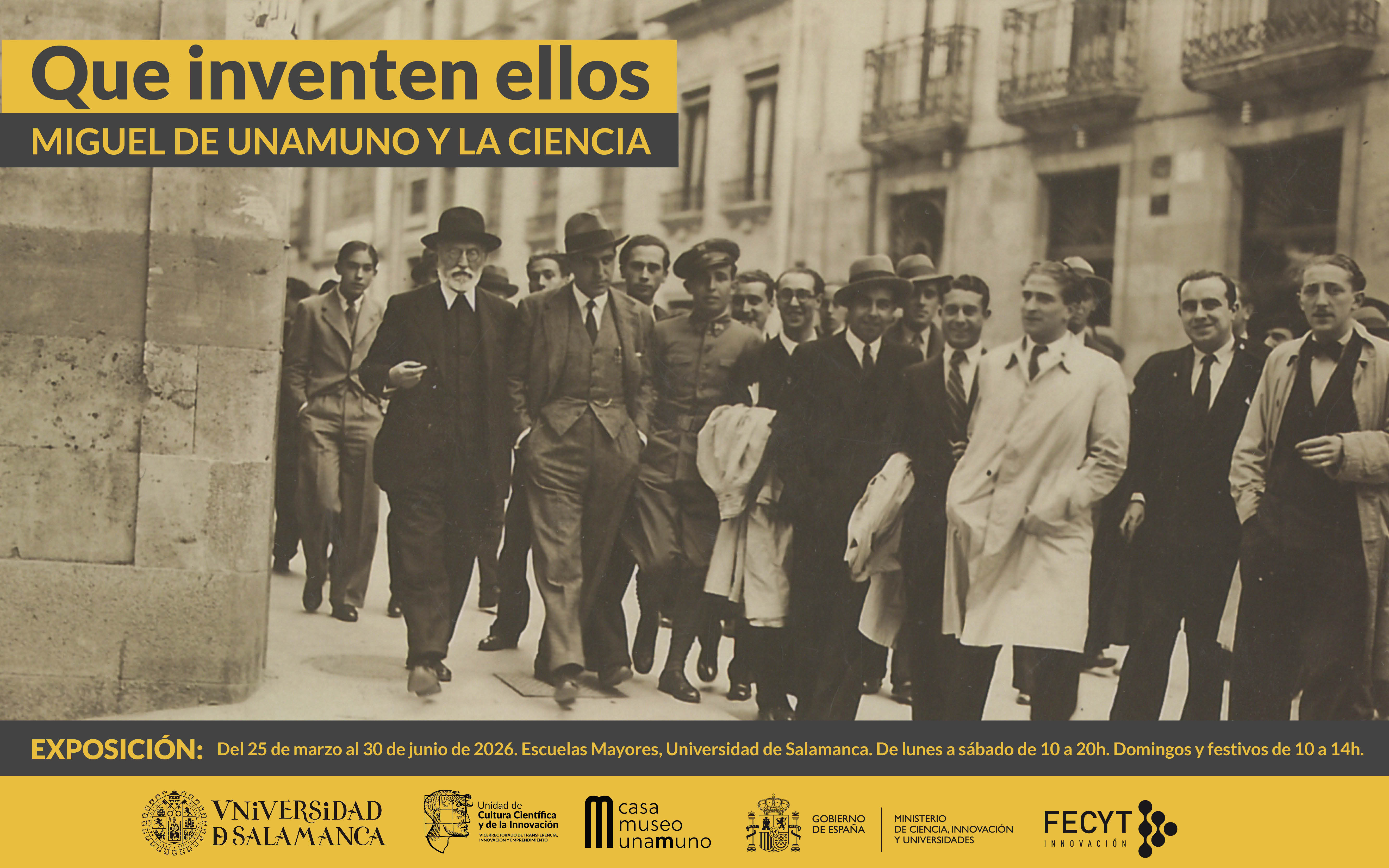
There are phrases that become tombstones. Epitaphs that history places upon the shoulders of their authors with such insistence that they end up crushing the complexity of an entire life. “¡Que inventen ellos!” (“Let them invent!”) is, without doubt, the most unjust sentence ever uttered in Spain about science—not because Unamuno said it with contempt, but because we heard it with laziness.
For more than a century, that phrase extracted from his essay En torno al casticismo (On Authentic Tradition, 1895) has served as a catch-all to justify Spanish scientific backwardness, as though the Rector of Salamanca had signed, on behalf of an entire people, a renunciation of curiosity. But now, in March 2026, the University of Salamanca inaugurates the exhibition “¡Que inventen ellos! Miguel de Unamuno y la ciencia” (“Let Them Invent! Miguel de Unamuno and Science”) and delivers something that history always kept tucked away in its drawers: the documents proving that Miguel de Unamuno was, secretly and in his own way, a man of science.
Or perhaps not so secretly. Perhaps it was we who did not know how to look.
The paradox of the philosopher and the scientist
There exists a canonical image of the Generation of ‘98 that pits it, almost by decree, against the scientific project of the Institución Libre de Enseñanza and its heirs. On one side, the agonists of the Spanish soul—Unamuno, Azorín, Baroja, Machado; on the other, the positivists of reason—Cajal, Bolívar, Llorente. Literary history, that great simplifier, drew a line between the two groups and then forgot to erase it.
But Santiago Ramón y Cajal and Miguel de Unamuno did not ignore each other. They read one another. They cited one another. And, as the documents now exhibited in the Escuelas Mayores reveal, they shared something deeper than the mere intellectual courtesy of an era: the same anguish before the limits of human knowledge.
Cajal, in his Charlas de café (Coffee-House Chat, 1920)—that collection of aphorisms and meditations which is perhaps his most intimate work—reflected on the relationship between science and doubt with a lucidity that Unamuno would have endorsed. And Unamuno himself, in Chapter IX of that same work, is invoked by Cajal when he speaks of “anti-self-ism” (antimismo)—that need to live outside oneself that the Bilbao-born philosopher had theorised. Two men, two methods, one and the same disquiet.
“Every man can be, if he sets his mind to it, the sculptor of his own brain.” (“Todo hombre puede ser, si se lo propone, escultor de su propio cerebro.”) — Santiago Ramón y Cajal, Tónicos de la Voluntad (Tonics of the Will, 1899)
Does not the same Unamunian conviction pulse within that sentence—that man is the maker of himself? The will as the raw material of the spirit—in Cajal as a scientific argument, in Unamuno as a philosophical agony.
Unamuno in the laboratory of the world
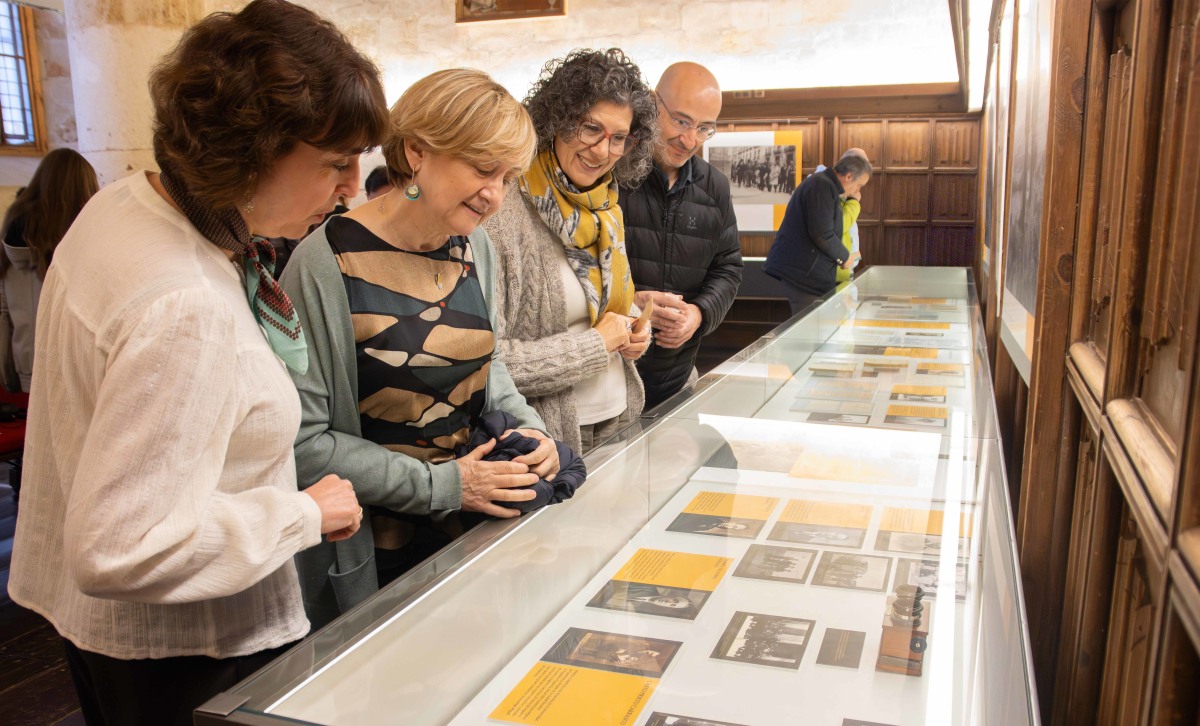
The exhibition, curated by Marta García Gasco, presents an unknown Unamuno. Not the polemicist who shakes university cloisters. Not the exile who writes from Hendaye with rage and nostalgia. But the voracious reader of scientific journals, the collector of optical instruments, the astonished correspondent exchanging letters with the greatest minds of his time.
For Unamuno’s links to international science are not anecdotal. They are structural.
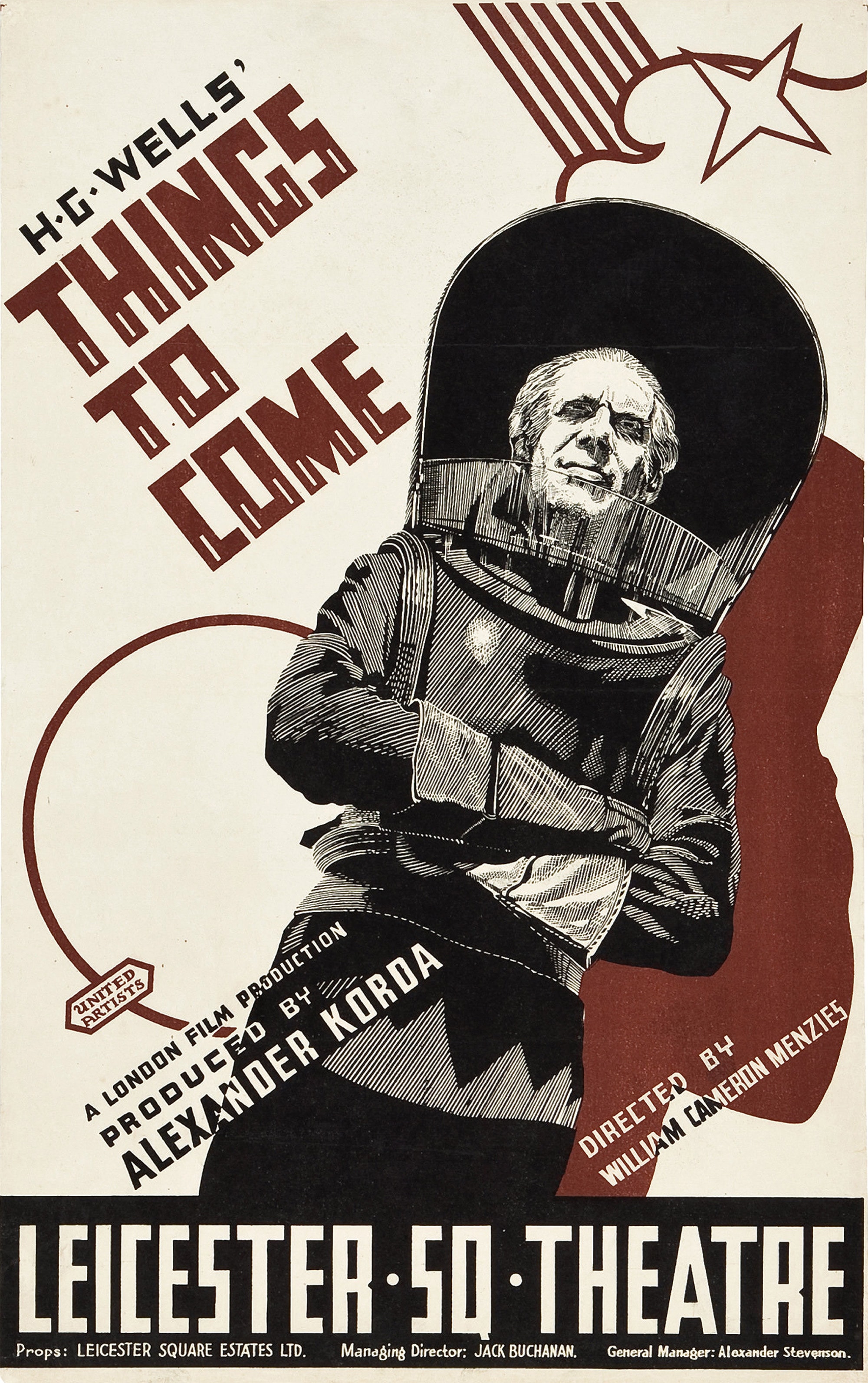
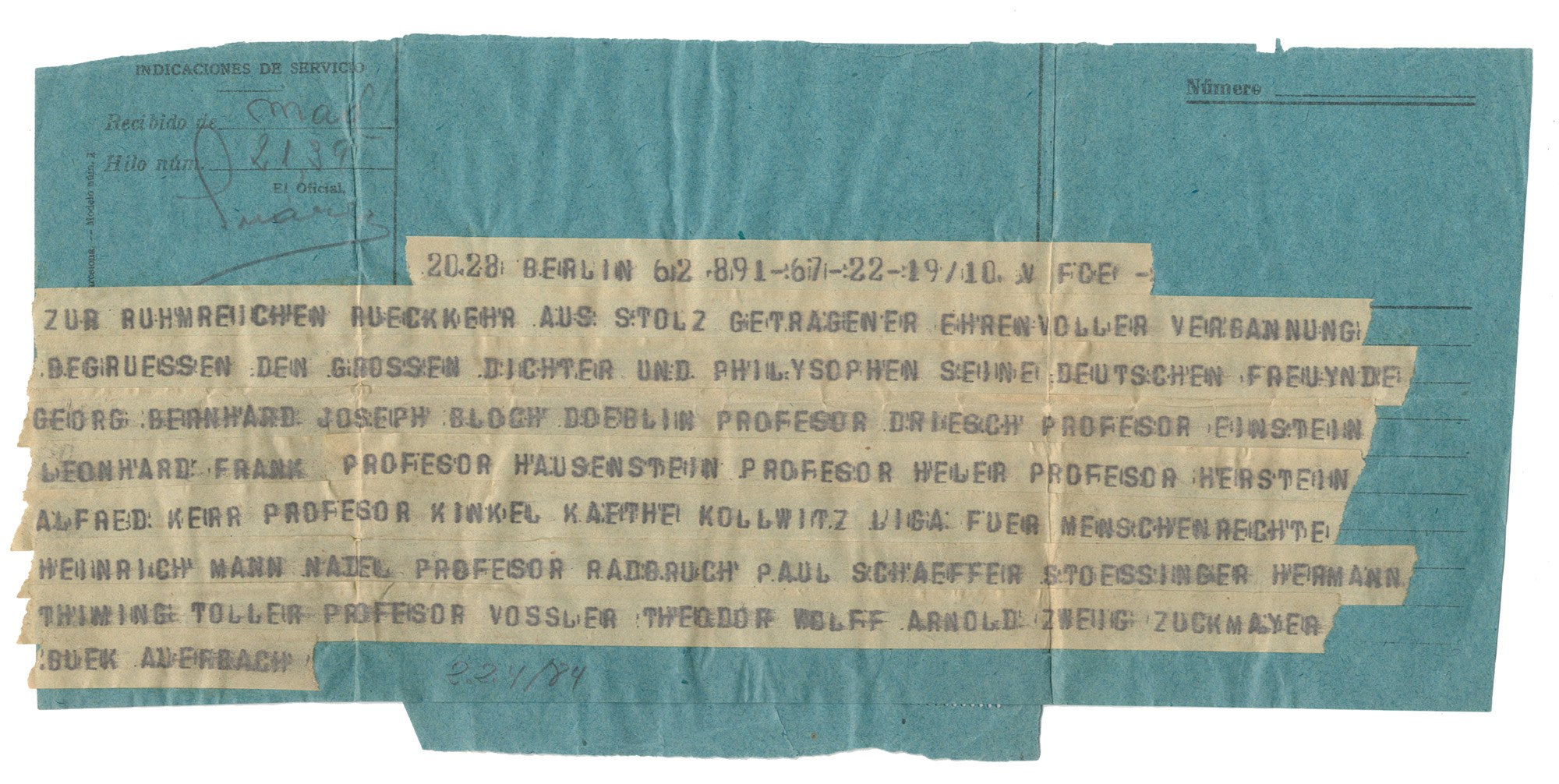
In the cloister of the Escuelas Mayores, reproductions of documents from the Bibliothèque nationale de France are exhibited for the first time, including the signature of Marie Skłodowska-Curie on a manifesto in support of Unamuno during his exile. Albert Einstein also spoke publicly in favour of the Salamancan rector. H. G. Wells completed that triangle of intellectual solidarity crossing the borders of knowledge and geography.
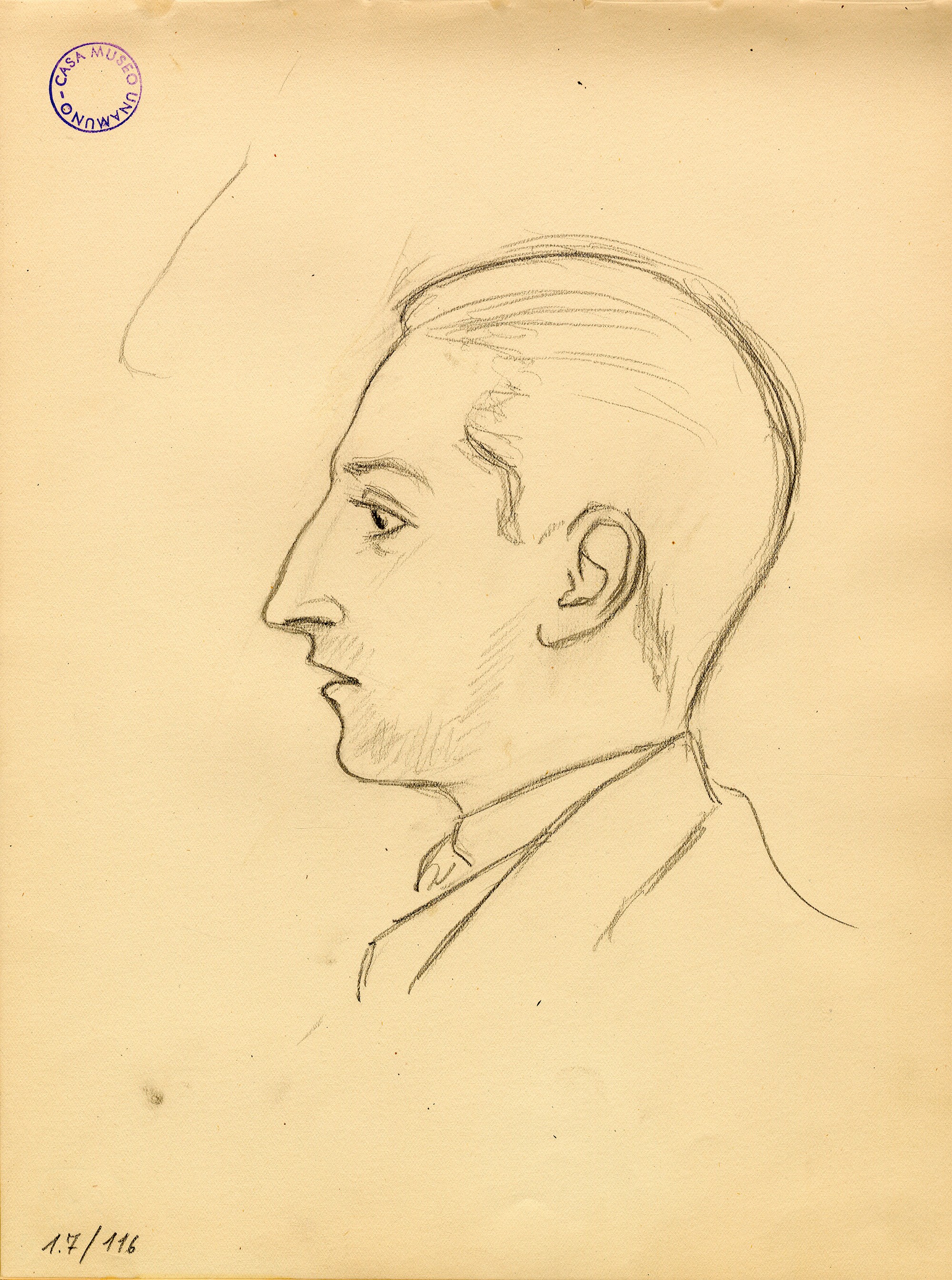
What did these giants of science and imagination see in Unamuno? They saw someone who, like them, had understood that the question is more important than the answer. That doubt—agonising doubt, doubt that hurts—is the most powerful engine of human thought.
Mecanópolis: a Spaniard’s first journey to the future
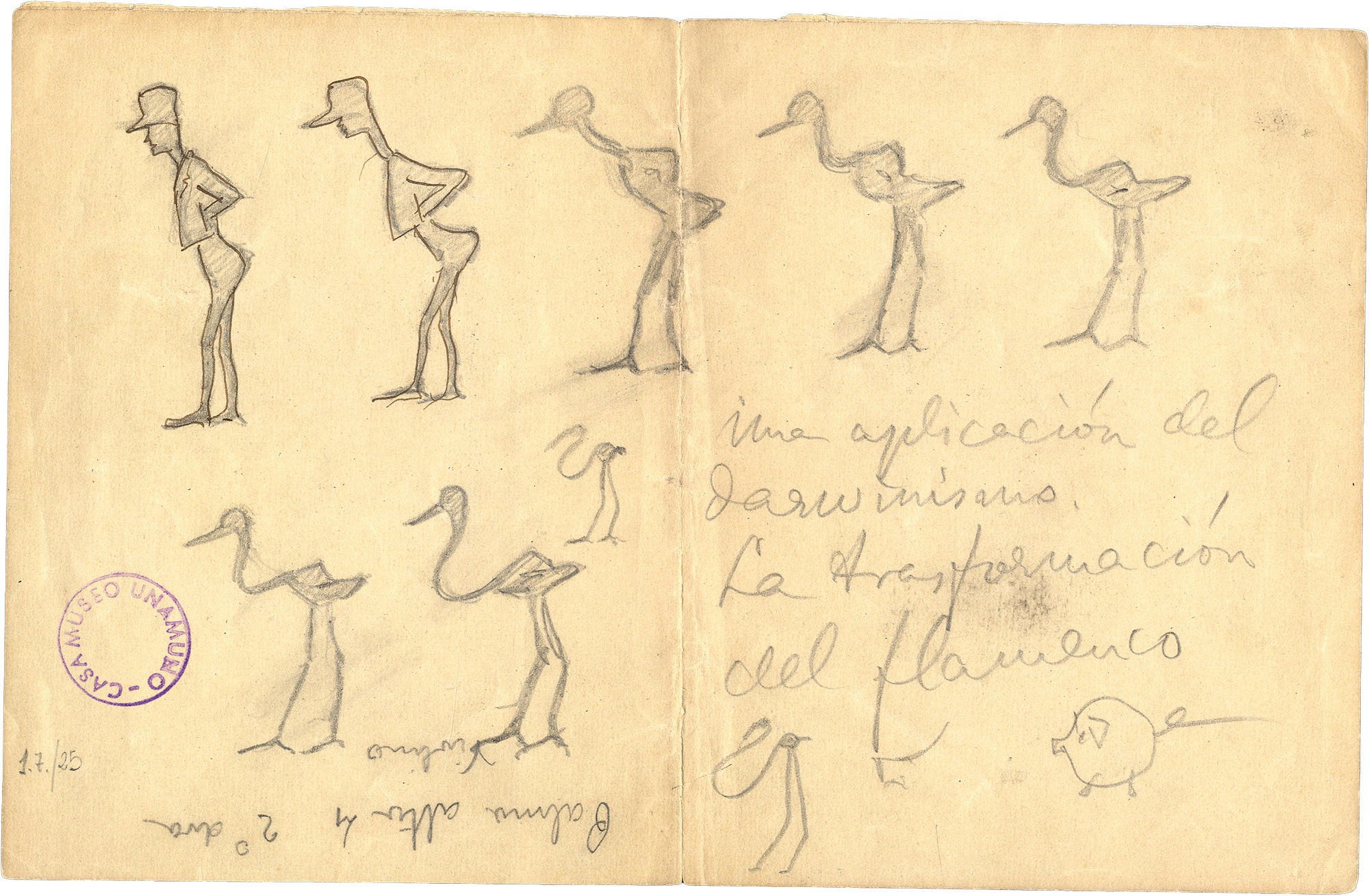
There is a detail that the Salamancan exhibition rescues from oblivion: Mecanópolis, Unamuno’s short story published in 1913, is considered one of the first science fiction texts written by a Spanish author.
In that brief and disturbing tale, a traveller arrives at a perfectly organised city where machines have replaced human beings in all their functions. The city works. It produces. It calculates. But it is dead of the only death that matters: the absence of anguish, of error, of humanity. The protagonist flees in terror.
To read Mecanópolis today, in the era of generative artificial intelligence, produces a vertigo that no prophet of Silicon Valley could have better anticipated. Unamuno, as early as 1913, had already intuited the question that will keep us occupied throughout the twenty-first century: what happens to the soul when machines are more efficient than the soul?
It is the same question, formulated from a different angle, that Cajal posed before his histological preparations. When the Nobel laureate observed the neuron doctrine—that revelation that the nervous system is composed of individual, discontinuous cells that communicate without touching—he was seeing, without knowing it, the hardware of the soul. And the question that discovery left hanging in the air was exactly Unamuno’s: where is the human in all of this?
The Vérascope and the microscope: two instruments for the invisible
One of the most fascinating objects in the exhibition is the Vérascope Richard, the stereoscopic viewer that belonged to Unamuno. Designed by inventor Jules Richard at the beginning of the twentieth century, it allowed one to contemplate photographs in three dimensions: it gave depth to the flat, relief to the two-dimensional, volume to the image.
It is impossible not to think, facing that instrument, of the other great optical apparatus of the era: the microscope of Santiago Ramón y Cajal. Both were machines for seeing what the naked eye cannot see. Both extended human perception into territories forbidden to the ordinary senses.
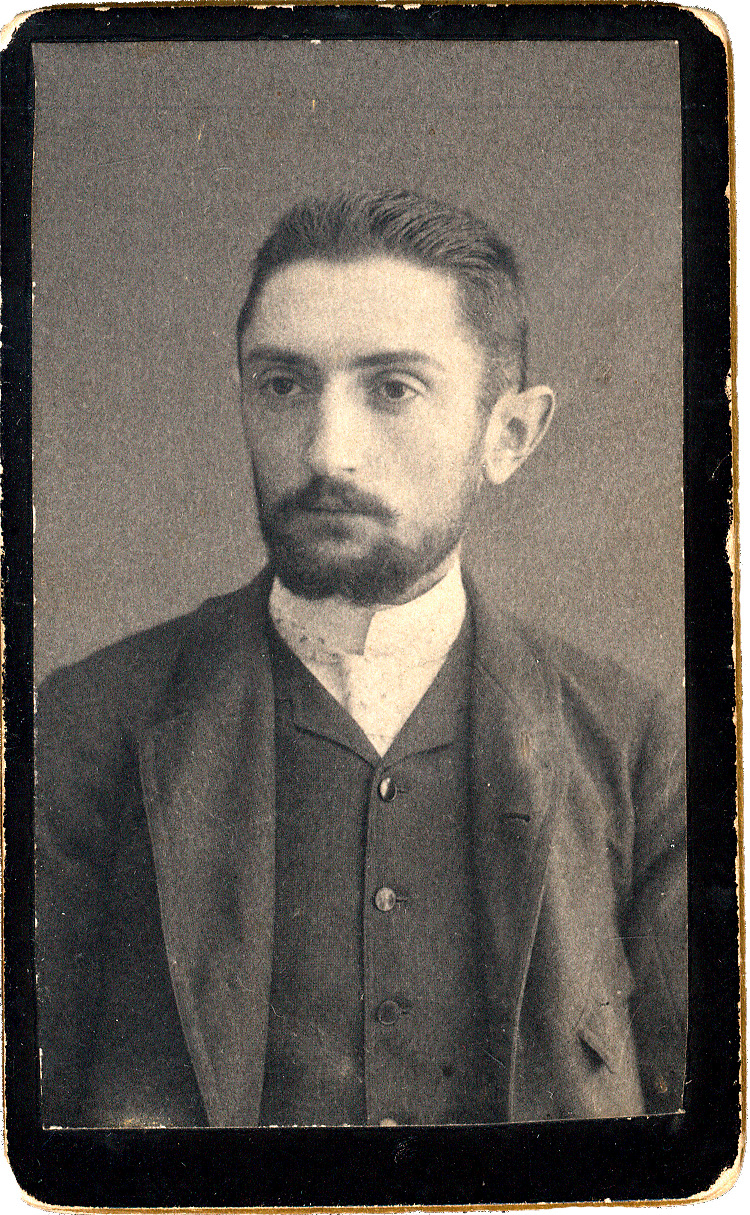
Cajal saw through his microscope the architecture of the nervous system: Purkinje cells with their dendritic trees like corals in an invisible sea; synapses—those abysses between neurons that do not touch yet communicate—as perfect metaphors for human solitude and connection.
Unamuno saw through his Vérascope an additional dimension, a depth that flat photography could not offer. He sought, in that artificial third dimension, something akin to what Cajal sought in his preparations: the illusion of having captured something essential, something that ordinary reality conceals.
Dolores Cebrián and the invisible women scientists
The exhibition also rescues the figure of Dolores Cebrián, a pioneer in science education in Spain and a friend of Unamuno. Her name, like that of so many women scientists at the turn of the century, had been submerged beneath the dominant current of a history written almost exclusively by and for men.
Cajal, from his position of scientific authority, was not immune to these tensions either. In the Cajal School that he established at the Instituto Cajal in Madrid, women such as Manuela Serra, Laura Forster, María Soledad Ruiz-Capillas, and María Luisa Herreros worked alongside the most celebrated disciples under conditions that history took a long time to fully acknowledge.
“Ideas do not last long. One must do something with them.” (“Las ideas no duran mucho. Hay que hacer algo con ellas.”) — Santiago Ramón y Cajal
”Let them invent!”: the phrase that needed an exhibition
The exhibition argues, with documents in hand, that “¡Que inventen ellos!” was not a declaration of surrender but a Socratic provocation: a philosophical sting aimed at stirring the Spanish conscience, at asking it what it was doing with its collective intelligence. Unamuno was not saying that Spaniards should not invent. He was saying that invention without human meaning is an empty machine—exactly what he describes in Mecanópolis.
Cajal, from the other end of the spectrum, answered that provocation with his entire life. His Nobel Prize in Physiology or Medicine in 1906, shared with Camillo Golgi, was the most emphatic possible demonstration that Spain could invent.
Unamuno and Cajal are, in this sense, two sides of the same coin of modern Spain: the one who asks about meaning and the one who works to find the answer. The one who demands that science have a soul and the one who demonstrates that the soul has a scientific structure.
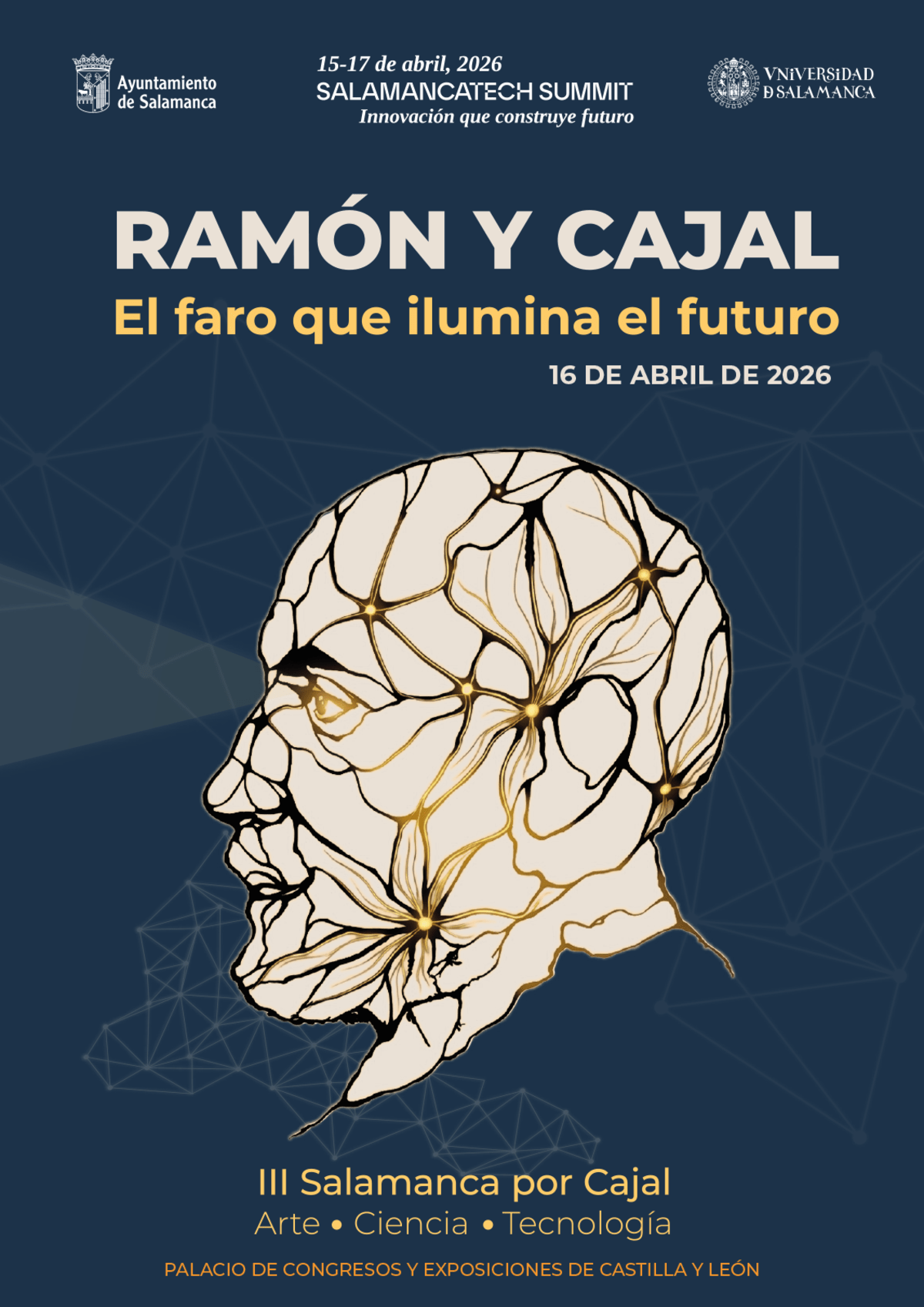
Salamanca, which now unites them in a single exhibition, is the fitting place for this reunion. And in this spring of 2026, just days before the III Salamanca por Cajal: Arte, Ciencia y Tecnología 2026 brings together the most brilliant scientists of the Spanish diaspora at the Palacio de Congresos de Castilla y León, this exhibition reminds us of something essential: that the conversation between science and the humanities in Spain has a richer and more complex history than the textbook writers would have us believe.
The legacy of a question
Both knew that knowledge is not a destination but a method. That what matters is not arriving but knowing how to walk. That a well-formulated question is worth more than a premature answer.
The exhibition concludes with a reading of letters in the Salón Rectoral of the Casa-Museo Unamuno on 8 June. Letters that the scientists of his era wrote to the philosopher. Voices of Einstein, of Curie, arriving from yellowed paper to tell us that the separation between science and the humanities was always an administrative fiction. That the great ones never believed it.
That we invented it—we, the small ones—so that we could sleep in peace.
Practical information
Exhibition: “¡Que inventen ellos! Miguel de Unamuno y la ciencia” (“Let Them Invent! Miguel de Unamuno and Science”) Organised by: Science Culture and Innovation Unit (UCC+i), University of Salamanca In collaboration with: FECYT and the Ministry of Science, Innovation, and Universities Curator: Marta García Gasco Venue: Cloister and Sala de la Columna, Escuelas Mayores — University of Salamanca Until: June 2026 Guided tours: Tuesdays, Wednesdays, and Thursdays · 6:30 pm · 20 places per session Registration: Registration form
Lecture series (all at 7:00 pm, free entry until full capacity):
- 25 March — Rafael Chabrán (Whittier College, California): Miguel de Unamuno y la ciencia. La cuestión palpitante · Aula Unamuno
- 27 April — Raúl Velasco (USAL): Tiempos de renovación: médicos y medicina en la Salamanca de Unamuno · Aula Salinas
- 4 May — José Antonio Ortega (USAL): Que inventen ellos… que tienen los incentivos para hacerlo. Los escritos de Unamuno sobre economía de la innovación · Aula Salinas
- 11 May — Cristina Erquiaga (UCM): ¿Y no hay otras puertas? España y la ciencia vistas por Unamuno · Aula Salinas
- 18 May — José Ángel Domínguez (USAL): Si Unamuno llega a dedicarse a las matemáticas… · Aula Salinas
- 25 May — Raúl Rivas González (USAL): Miguel de Unamuno y H. G. Wells: una relación de ciencia-ficción · Aula Salinas
- 1 June — Marta García Gasco and Ana Chaguaceda: Presentación del proyecto Google Arts & Culture «Que inventen ellos» · Aula Salinas
- 8 June — Reading of letters: Unamuno y la ciencia · Salón Rectoral, Casa-Museo Unamuno
Source: “¡Que inventen ellos! Miguel de Unamuno y la ciencia” — Science Culture and Innovation Unit, University of Salamanca. Photographs © UCC+i USAL / Raquel J. Santos, reproduced for educational and outreach purposes.
Bibliography and References
Villar Ezcurra, A. (2015). Miguel de Unamuno: Una ciencia y una religión para la vida. Pensamiento. Revista de Investigación e Información Filosófica, 71(269), 1499–1508. https://revistas.comillas.edu/pensamiento/es/article/view/6597
Giné, E., Martínez, C., Sanz, C., Nombela, C., & de Castro, F. (2019). The Women Neuroscientists in the Cajal School. Frontiers in Neuroanatomy, 13, 72. https://doi.org/10.3389/fnana.2019.00072
de Castro, F. (2019). Cajal and the Spanish Neurological School: Neuroscience Would Have Been a Different Story Without Them. Frontiers in Cellular Neuroscience, 13, 187. https://doi.org/10.3389/fncel.2019.00187
Sánchez Álvarez-Insúa, A. (2007). Con el pensamiento vivo de Cajal cien años después. Arbor, 183(727), 631–635. https://doi.org/10.3989/arbor.2007.i727.132
Villar Ezcurra, A. (2013). La crítica de Unamuno al cientificismo. Pensamiento. Revista de Investigación e Información Filosófica, 69(261), 1035–1048. https://repositorio.comillas.edu/rest/bitstreams/72454/retrieve