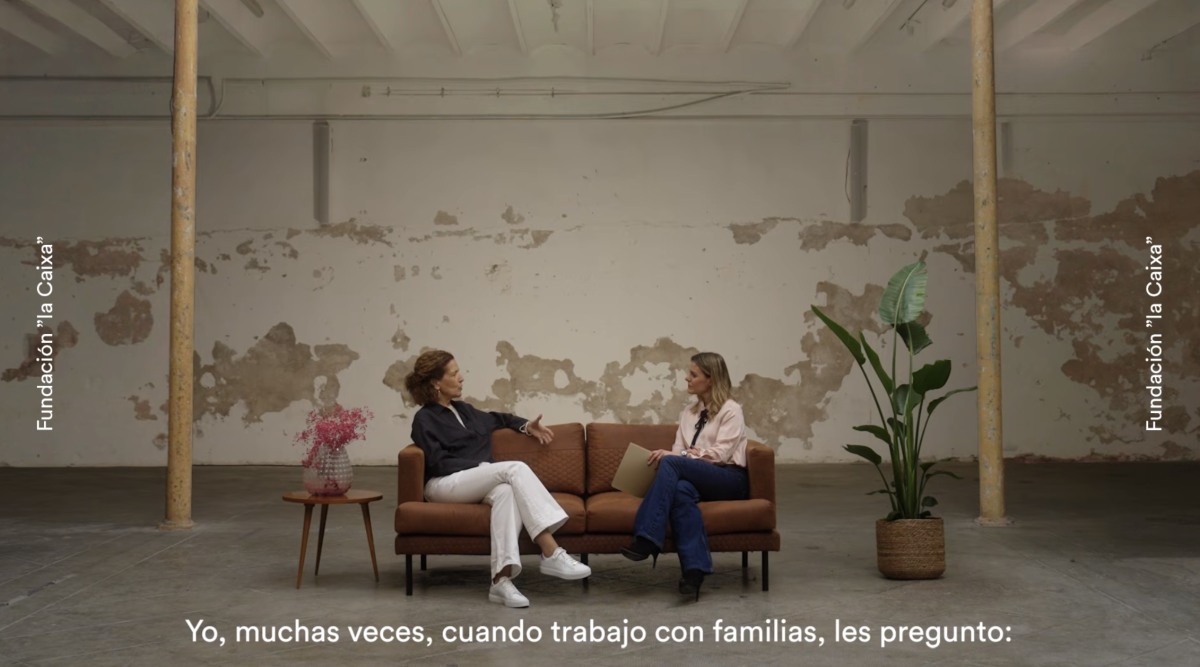
The experience of grief is one of the most universal yet silenced phenomena of the human condition. In our society, which tends to medicalise sadness and avoid suffering, individuals often live loss in isolation. Initiatives such as the dialogue “Una mirada al duelo” (“A Look at Grief”), promoted by the “la Caixa” Foundation and led by journalist Andrea Ropero alongside psychotherapist Alba Payàs, are vital to deconstruct and educate society about the reality of loss.
Key insights from “Una mirada al duelo” (YouTube)
- How long does grief last? There is no exact end date, since it is an experience intrinsic to life itself. However, the one-year threshold is highlighted as a moment to assess the need for support, and it is crucial that the surrounding environment maintain its support even one or two years after the loss.
- Can it be overcome? Alba Payàs clarifies that grief is not “overcome” like an obstacle left behind; rather, one learns to live with it. Processing it correctly enables a better response to future adversities.
- When is professional help useful? When, after a year, the person feels “deeply sunk”, is unable to resume daily life, or shows extreme and persistent feelings of guilt or anger.
- Tips for accompanying: Prioritise presence and active listening, avoid clichés (“time heals everything” or “distract yourself”), and try not to “halt” another person’s pain.
The multidimensional phenomenology of loss
Grief is not a simple transient emotion or an illness; it is a systemic crisis that shatters the individual’s beliefs. It breaks the survivor’s life narrative, throwing them into a total redefinition of identity in the face of emptiness.
Nor is there a “timetable” for pain. Grief does not expire, because ontologically it implies learning to coexist with absence. Clinically, however, the first-year threshold is set as a turning point: if disabling dysfunction persists after twelve months, therapeutic support should be considered. Ironically, it is during this very period that the social environment tends to withdraw its support, deepening isolation.
| Dimension | Clinical manifestations | Long-term implications |
|---|---|---|
| Biological | Insomnia, fatigue, physical pain, immunosuppression. | Risk of somatisation and organic disorders. |
| Affective | Sadness, ruminative guilt, anger, emotional numbness. | Major depression or anxiety if socially invalidated. |
| Behavioural | Social isolation or evasive hyperactivity. | Deterioration of the interpersonal support network. |
| Existential | Derealisation, loss of meaning and questioning. | Spiritual crisis or sustained post-traumatic growth. |
From passive stages to active tasks: the integrative-relational model
The classic paradigm of “passive stages” has evolved. Psychotherapist Alba Payàs, trained alongside the pioneer Elisabeth Kübler-Ross and director of the IPIR Institute, proposes in her work Las tareas del duelo (“The Tasks of Grief”) an integrative-relational model. This approach abandons the idea that time heals passively and establishes five “tasks” of active and non-linear processing:
- Shock and self-preservation: A neurobiological response of numbness and dissociation (derealisation) that prevents immediate mental collapse before the magnitude of trauma.
- Dosed denial (adaptive avoidance): A protective mechanism that meters out pain. It allows brief incursions into reality and tactical retreats to maintain balance.
- Integration and connection: The painful descent into the emotional epicentre. A deep confrontation with irreversible reality, allowing the catharsis of anger, sadness and existential terror.
- Letting oneself be loved: Overcoming the isolation intrinsic to suffering and allowing the environment (despite its usual emotional clumsiness) to act as support and emotional container.
- Transformation and reconstruction of meaning: The ethical culmination. It does not mean forgetting, but integrating the deceased’s legacy by rebuilding the survivor’s identity and life purpose.
The myth of “overcoming” loss
In this model, the term “overcoming” is regarded as a harmful semantic fallacy. One does not overcome a death; one learns to live in a radically new way. When properly elaborated, transmuted grief fosters profound post-traumatic growth, amplified empathy and a reorganisation of values, honouring the legacy of the one who is gone.
Systemic ecosystem and compassionate literacy
Grief impacts the entire family system, frequently generating the phenomenon of “invisible grief” in children. Parents, immersed in their own suffering, may become temporarily emotionally unavailable. This involuntary affective abandonment constitutes a serious aetiological risk for future psychopathology in children if there is no psychoeducational intervention within the family nucleus.
At the social level, true accompaniment requires deconstructing our own discomfort in the face of others’ suffering.
| Approach to accompaniment | Iatrogenic (toxic) intervention | Therapeutic (healing) intervention |
|---|---|---|
| Linguistic | Coercive clichés: “you must be strong”, “time heals everything”. | Validation of pain, active listening, reverent and present silence without judgement. |
| Time management | Tacit demand for normality after the first year. | Actively maintain interest and support years later. |
| Emotional handling | Trying to distract or stop tears out of one’s own discomfort. | Tolerating ambivalence (catharsis and avoidance), respecting the mourner’s rhythms. |
| Spirituality | Minimising pain by hiding behind dogma (“they are in a better place”). | Integrating belief as a source of meaning, while allowing the physical, real pain of temporal absence to be lived through. |
When grief suffers severe stagnation, pathological emotional fixation (chronic guilt or anger) or structural cognitive dissonance (permanent psychotic denial) after one year, the normative process turns into prolonged grief disorder, which requires inexcusable referral to specialised psychotherapy.
Institutionalising care: the “la Caixa” Foundation
In the face of the traditional biomedical model’s insufficiency to manage agony, the Comprehensive Care Programme for People with Advanced Illnesses of the “la Caixa” Foundation (launched in 2008 and endorsed by the WHO) emerges as a colossal humanitarian response.
- The EAPS (Psychosocial Care Teams): 65 interdisciplinary teams with more than 320 professionals operate nationwide in hospitals, homes and residences.
- Tangible impact: They have historically cared for more than 300,000 patients and 385,000 family members. As an example, the Granada node (FIBAO) alone attended to 3,000 patients and 3,300 family members between 2009 and 2015.
- Holistic approach: They actively prevent complicated grief by maintaining accompaniment after death, address the spiritual dimension while respecting the plurality of beliefs, and care for the mental health of healthcare professionals to prevent burnout.
The programme is also sustained by more than 1,000 rigorously trained volunteers who fight “total pain” and unwanted loneliness. This altruistic work performs a bidirectional therapeutic miracle: it offers comfort and strength to the patient, and radically transforms the volunteer, stripping away frivolity and anchoring them to peace, empathy and the primal essence of life.
Conclusion
Integrating the expert clinical vision of therapists such as Alba Payàs with the social-health muscle of initiatives such as the “la Caixa” Foundation’s is a civic imperative. Grief is a transpersonal and courageous pilgrimage. It does not seek amnesia or pharmacological suppression, but the majestic reconstruction of the human psyche. It consists of making space for immense pain in the heart while never ceasing to honour and celebrate the unstoppable miracle that human life is.